
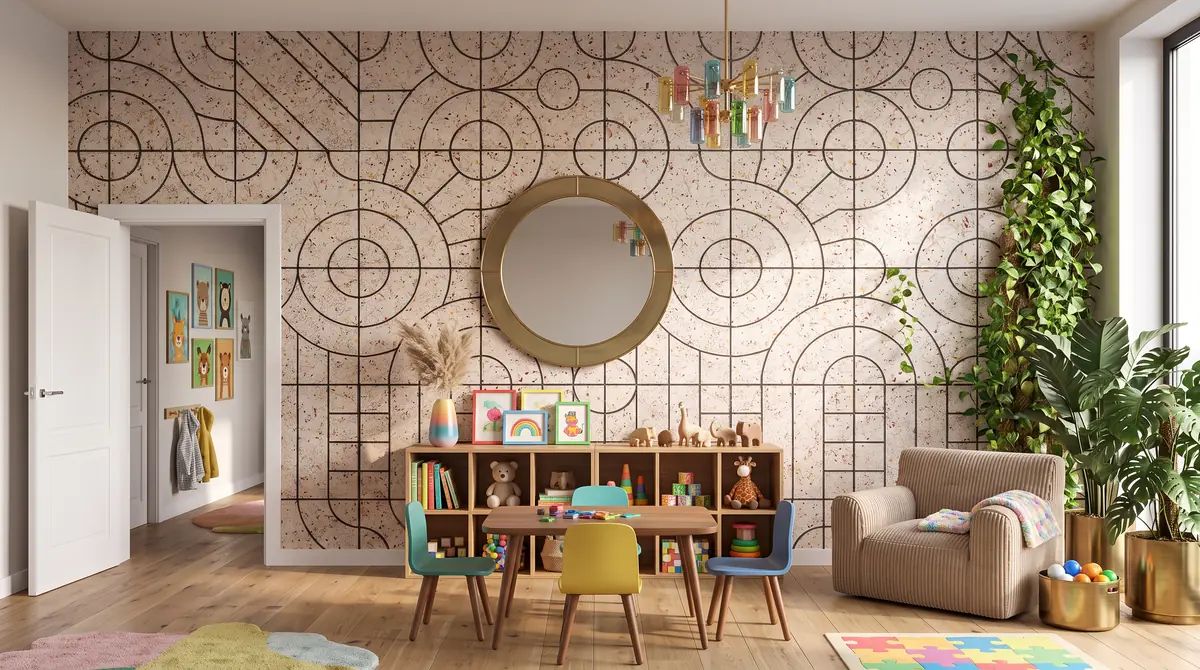
A room that echoes does not get better when everyone talks more quietly. Conversations blur, the TV gets turned up, and after an hour-long meeting everyone is tired. The cause is rarely the people and almost always the surfaces: in rooms with many hard, smooth surfaces, sound is reflected instead of absorbed. What helps is not insulation, but sound absorption on the right surfaces.
This guide shows you how to improve room acoustics: how to recognise poor acoustics, which figures on a data sheet really matter, and why the distance to the wall decides how well acoustic panels and other sound absorbers perform. We then walk through ORGANOID products as examples, from Modular to Infinity and from Acoustic Tiles to the acoustic ceiling cloud, along with the different decors. All figures come from test reports to EN ISO 354.
Contents
Signs that the problem is your room acoustics
Three signs that, taken together, are fairly clear:
- Reverberation. A clap, a cupboard door, a chair scraping the floor: the sound lingers noticeably longer than you expect.
- Speech intelligibility. You cannot make out the words even though it is loud enough. At the end of the table, in the next room, on a video call.
- Listening fatigue. Listening takes concentration. Offices, restaurants and meeting rooms notice this first.
Sound absorption is not sound insulation
The two terms are constantly confused, and the mix-up regularly leads to the wrong purchase:
- Sound absorption works within a room. It takes energy out of sound that is already there, which reduces echo and improves intelligibility. This is where you start when room acoustics are poor.
- Sound insulation works between two rooms. It stops noise from next door getting in. That is a question of the building element: wall build-up, door, ceiling, floor.
Acoustic panels, often sold as sound absorbing panels, sound dampening panels or even soundproof panels, belong to sound absorption. A sound absorber on the wall makes the room quieter. It does not make the wall more soundproof. If your neighbours are the problem, an acoustic panel is the wrong answer. If your own room wears you out, it is the right one.
The three key figures, and one trap
How well a product absorbs sound can be measured. The method is EN ISO 354, a measurement in a reverberation room.
- αw: the weighted sound absorption coefficient. It shows how well a material absorbs sound. The value ranges from 0 to 1.0: 0 means sound is almost entirely reflected, 1 means sound is almost entirely absorbed.
- Absorber class: groups αw into classes from A to E. A is the best.
- NRC: the noise reduction coefficient, another figure for sound absorption based on the US standard. Mathematically it can come out slightly above 1.00. That is not an error but a measurement effect that can be caused by the edges of the test sample.
The trap: αw applies to surfaces. An acoustic picture is not a surface but an object, so what is measured is its equivalent sound absorption area Aobj in square metres per object. Comparing a picture using αw therefore does not work. You compare how many square metres of absorption an object adds.
Important: every test value only applies to the test set-up it was measured in. The next section shows why that matters so much.
The distance to the wall matters more than the material
This is where most projects are won or lost: the same acoustic panels, the same material, the same area, but mounted differently and with different backfill. We tested every decor we offer in several mounting variants.
| Test set-up αw · class | ALPINE MEADOW light | PURE | WOOL |
| mounted directly | 0.50 · D | 0.45 · D | 0.55 · D |
| 40 mm backfill | 1.00 · A | 1.00 · A | 1.00 · A |
| 180 mm distance to the wall | 1.00 · A | 1.00 · A | 1.00 · A |
| 140 mm distance and 40 mm backfill | 1.00 · A | 1.00 · A | 1.00 · A |
Backfill: 40 mm sheep’s wool insulation
This is the most important figure in this guide: mounted directly on the wall, all three decors sit between 0.45 and 0.55, which is class D. With backfill, with a wall gap or with both, all three reach 1.00, class A. The decor makes a difference of 0.10, the mounting up to 0.55.
The distance to the wall has a decisive influence on acoustic performance. The air space behind the absorber is therefore not just a mounting detail but an essential part of the acoustic build-up. If the panel is glued directly to the wall, a large part of its absorption potential is left unused. That is why the substructure should be planned from the start, before the final choice of product is made.
Not sure which set-up is possible in your room? Send us your room dimensions, the key features of the space and a few photos. We will show you which ORGANOID solution gives your room the best possible acoustics.
Our products: Modular and Infinity
There are two product families. The key difference is the absorber core.
Modular
The core is the Active Core, made of hemp fibres with a biodegradable binding fibre. Our Acoustic Tiles, Acoustic Panels and Acoustic Pictures are built on this absorber core.
Infinity
The absorber core is an MDF board. It is the basis of the Fine & Bold, Wall, Sky and Fly product lines.
Modular
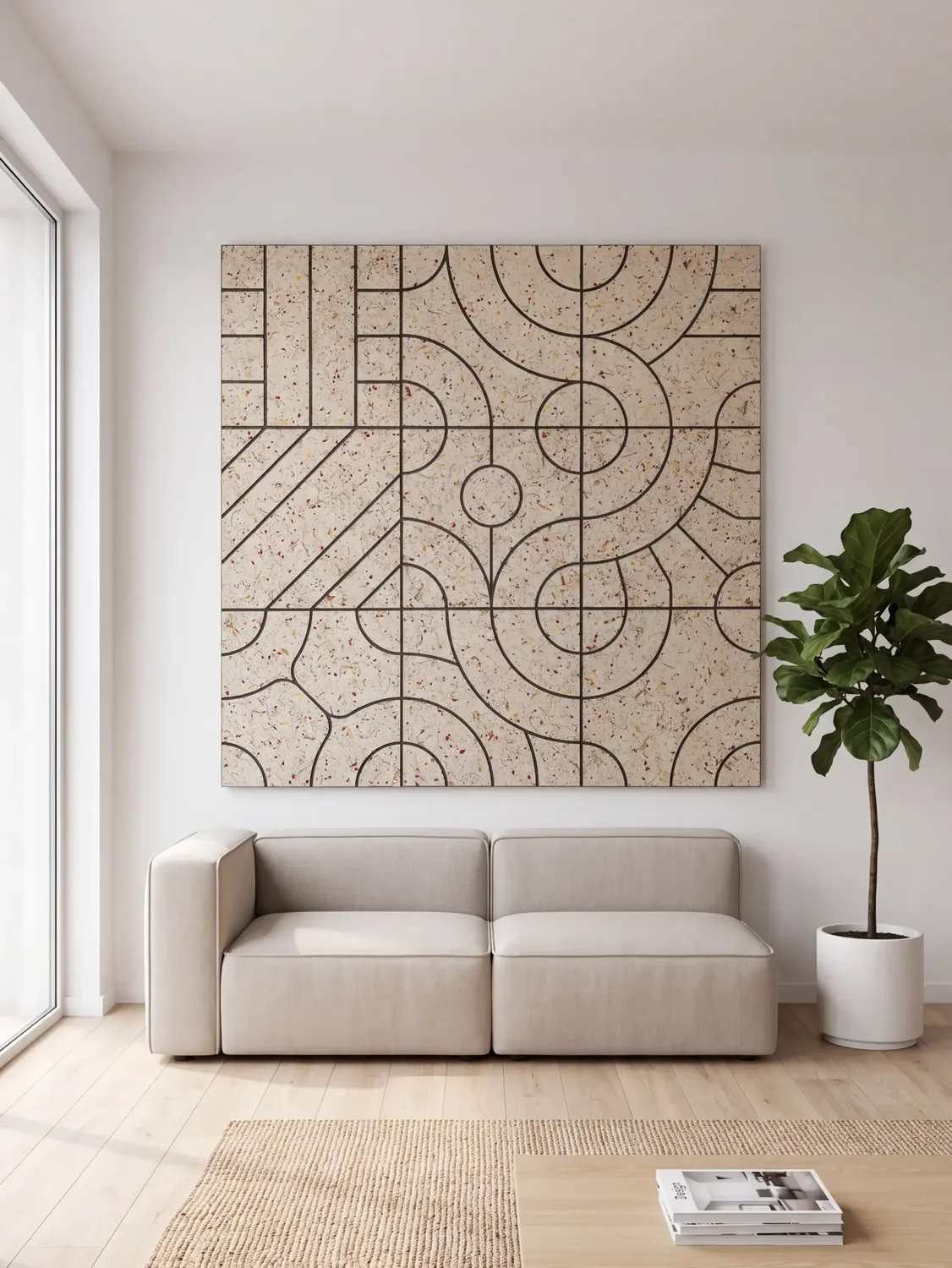
Acoustic Tiles: creative wall surfaces
Individual tiles, 580 × 580 × 20 mm, from four pieces. There are nine designs: GRID, CIRCLES, LOOPS, HYBRID, LINES, CELLS, BLOOM, PEARLS and SUN, which can be combined freely. All nine use the decor ALPINE MEADOW light. The difference lies in the V-cut of each tile.
Acoustic Tiles are designed for use on walls.
Modular
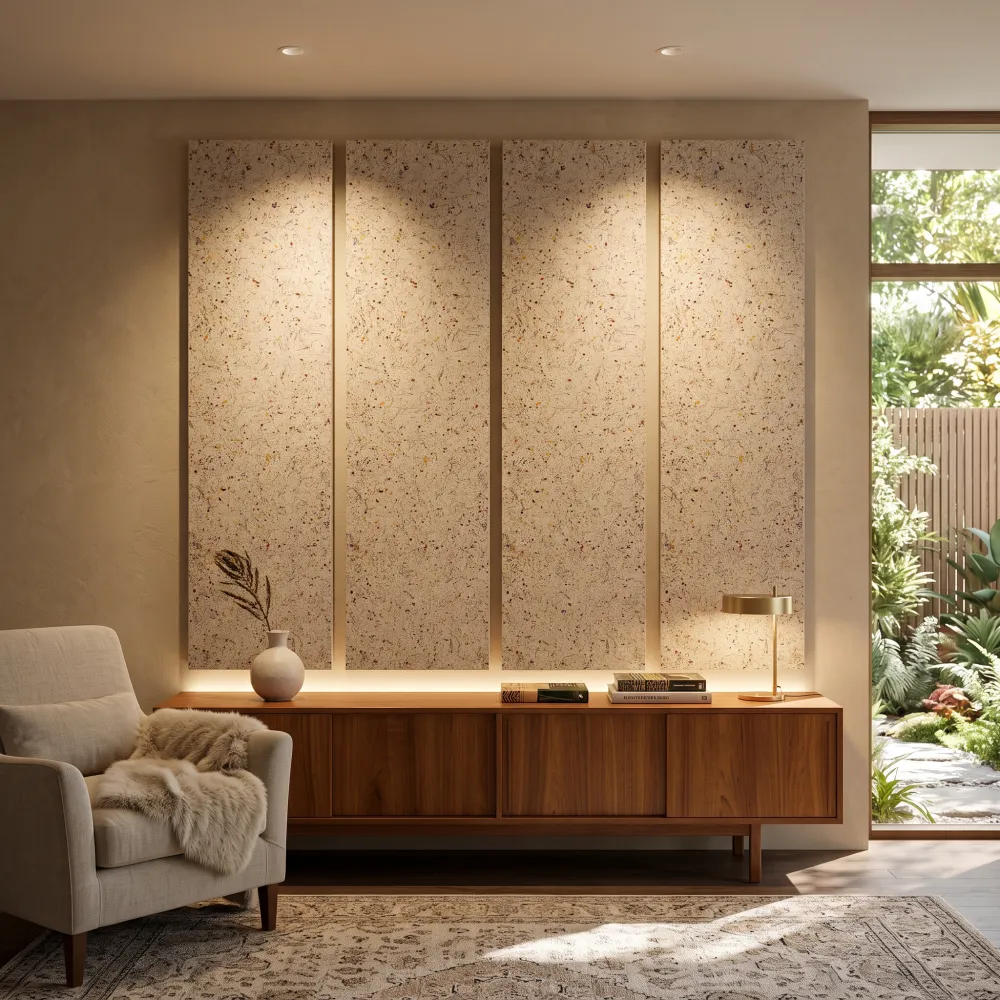
Acoustic Panels: for large-area absorption
Two widths, 580 and 1160 mm, each 2320 mm high and 20 mm deep. This is where you get the widest choice of decors:
- PURE: the unlaminated Active Core with visible hemp fibre
- ALPINE MEADOW light: real alpine hay with flowers
- WOOL white and WOOL sage green: felt made of real sheep’s wool

Modular
Acoustic Pictures: an effective accent
Two formats, 600 × 600 and 1200 × 600 mm, each 40 mm deep, with either a folded edge or a black wooden frame. The decor of the Acoustic Pictures is ALPINE MEADOW light.
Infinity
Acoustic slat panels Infinity Fine & Bold
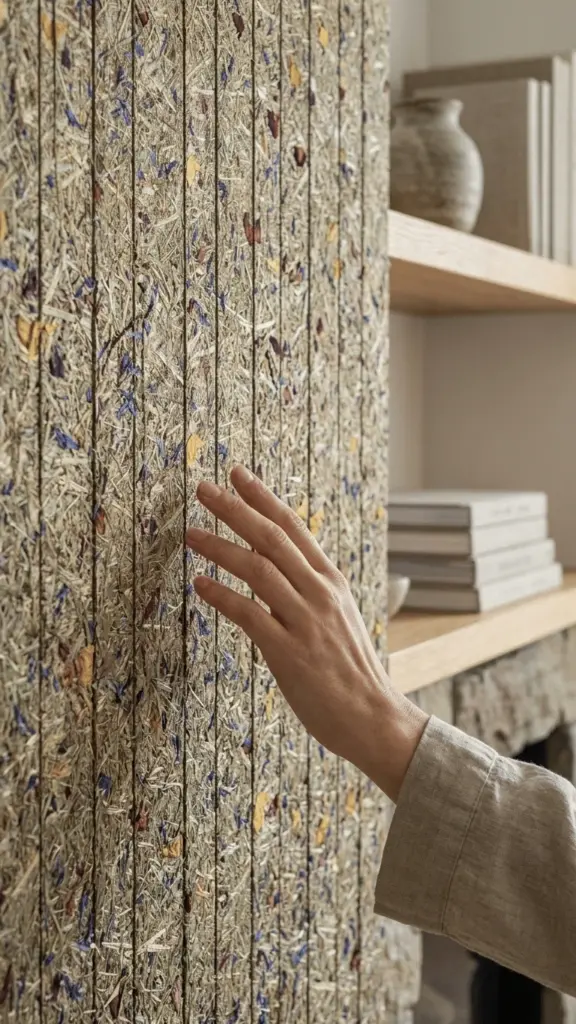
Infinity Fine & Bold feature a continuous slat look in a 2780 × 128 mm format and join seamlessly via a tongue-and-groove connection with screw clips. The key difference between Fine and Bold is the width of the slats. It affects not only the look but also the acoustic performance.
Bold is available with the decor ALPINE MEADOW, Fine with ALPINE MEADOW light.
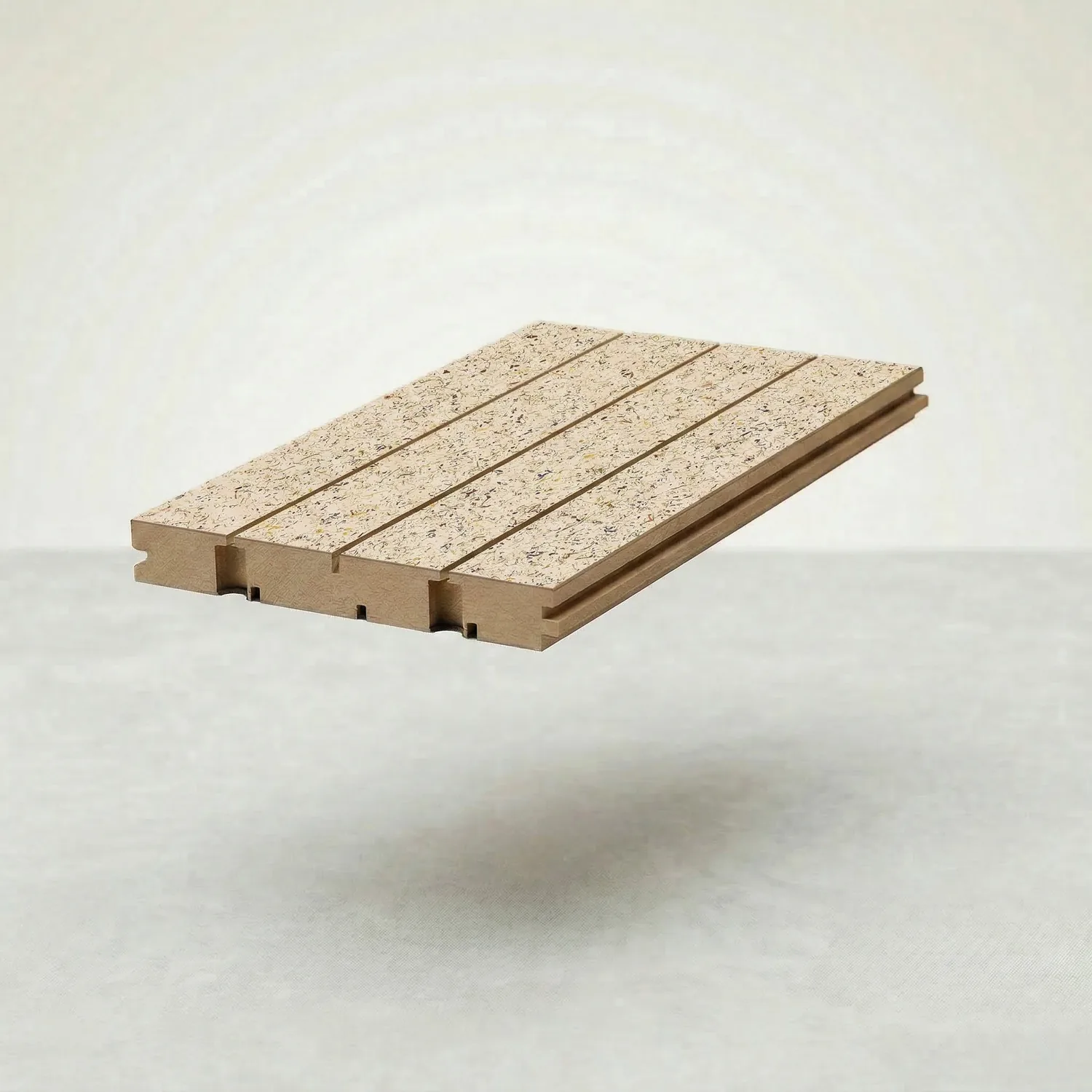
| Test set-up αw · class | Fine 14 mm slat width | Bold 30 mm slat width |
| 56 mm distance, 30 mm backfill | 0.85 · B | 0.50 · D |
| 216 mm distance, 30 mm backfill | 0.90 · A | 0.55 · D |
Measured to EN ISO 354
Infinity
Infinity Wall & Sky
Wall and Sky share the format 2000 × 1000 × 76 mm. Wall is designed for wall mounting and is fixed with the screw hooks supplied. Sky is designed to be mounted as a ceiling absorber.
Infinity
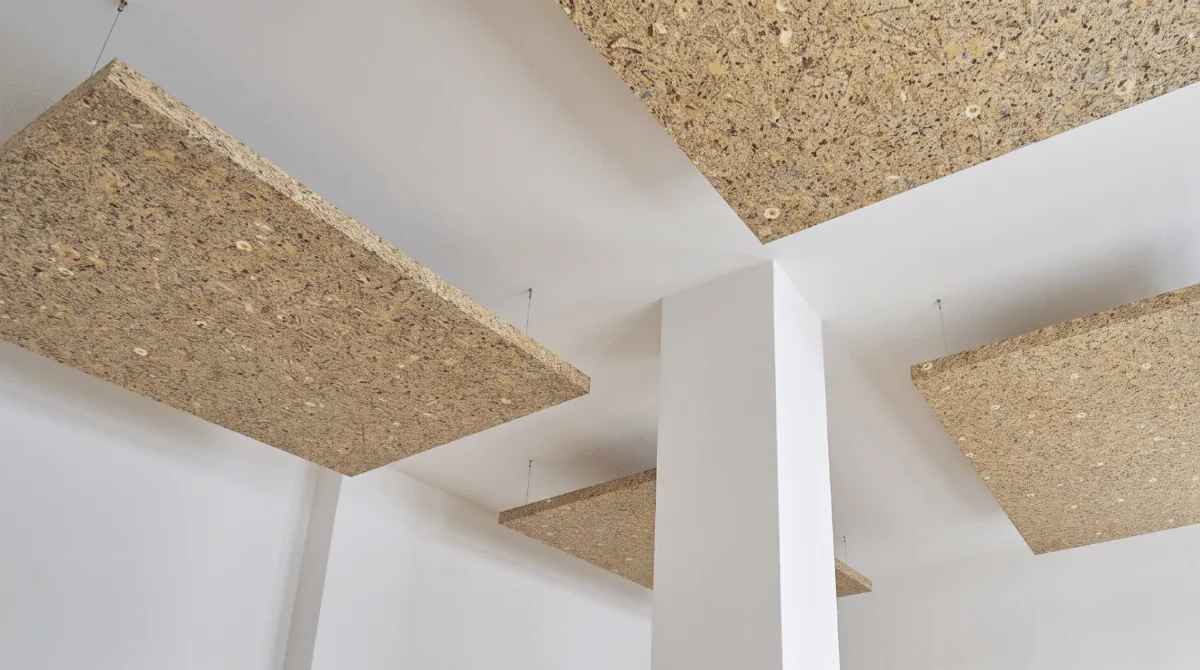
Infinity Fly: acoustic ceiling cloud
The ceiling cloud in the format 2000 × 1000 × 76 mm is suspended freely below the ceiling. The Reutlinger wire-rope holders required are included. The distance to the ceiling is an essential part of how it works: the air space created allows the ceiling cloud to absorb particularly effectively. It is ideal when the existing ceiling should not be clad or altered.
A natural surface has to be seen and touched. That is why every decor is available as an A5 sample.
Acoustic panel ideas: room acoustics as a design element
A sound absorber does not have to be hidden. Planned well, decorative acoustic panels become part of the architecture. A few ideas for using ORGANOID products:
- Feature wall behind the sofa or TV: a continuous area of Acoustic Panels calms the room and adds a quiet material accent, for example in WOOL sage green or ALPINE MEADOW light.
- Your own pattern with Acoustic Tiles: the nine V-cut designs of the Acoustic Tiles can be combined freely, for example as a 3 × 3 area above the sofa or in a meeting room that works like a piece of wall art.
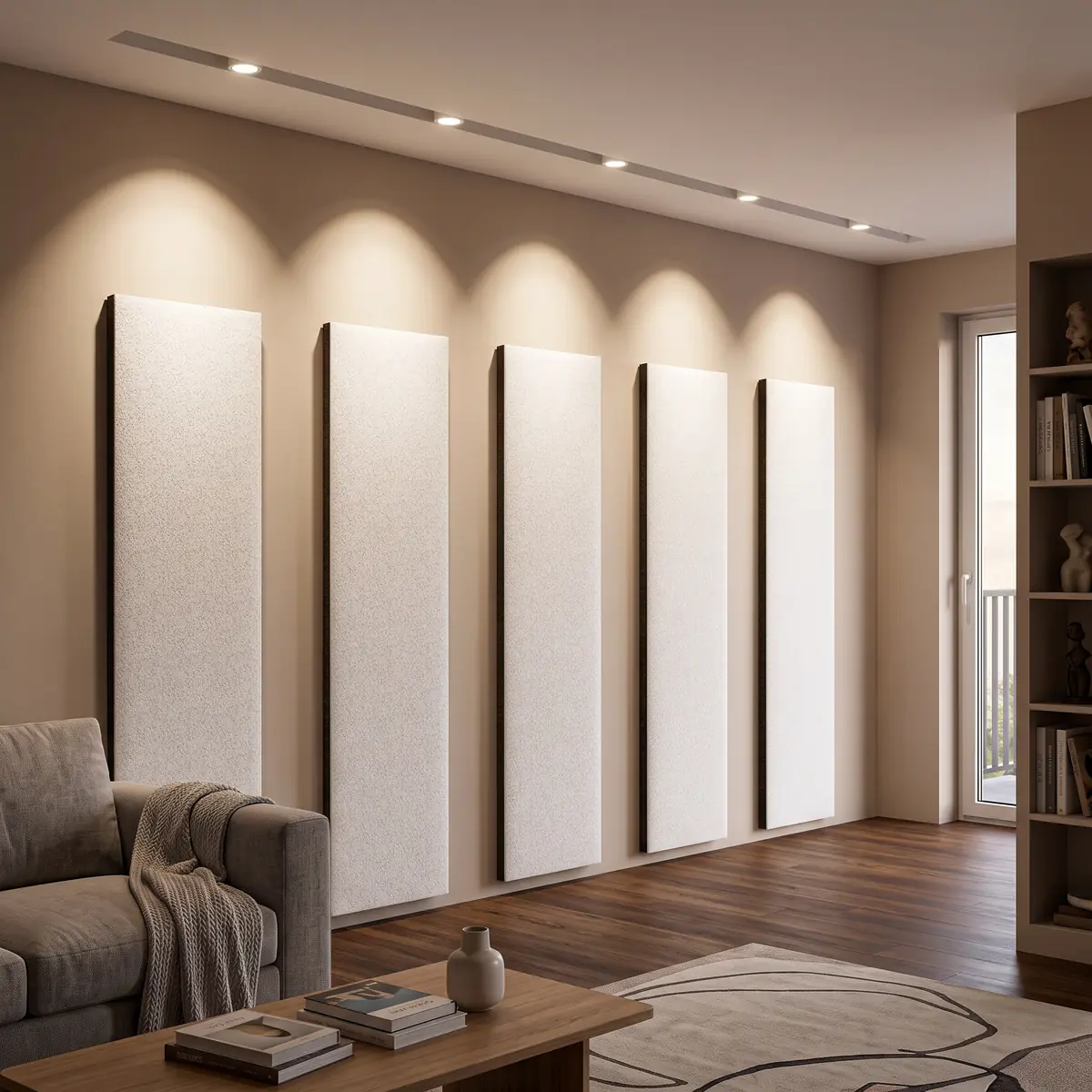
- Slat wall in reception or conference rooms: Infinity Fine & Bold run seamlessly across the full width of a wall. The continuous slat look structures large surfaces and absorbs sound at the same time.
- Ceiling cloud above the table: an Infinity Fly above a meeting or restaurant table absorbs sound where people talk and leaves the existing ceiling untouched.
- Wall and ceiling in the same decor: the products of the Infinity family can be combined. Wall on the wall and Sky on the ceiling create a consistent material look.
- Acoustic Pictures as a series: several Acoustic Pictures in a row above a sideboard or along a corridor work as acoustic wall art, and their absorption adds up.
Installing and cutting to size
The fixing method also determines the distance to the wall, and with it the performance. Each system has its own installation guide in the download area.
- Acoustic Panels: adhesive film, acoustic rails or mounting adhesive
- Acoustic Tiles: power magnets with a 4.5 mm gap, adhesive film or mounting adhesive
- Acoustic Pictures: mounted with nails
- Fine & Bold: screw clips on horizontal battens
- Wall: screw hooks, included
- Fly: wire-rope holders, included
Cutting to size: despite its natural fibre content, the Active Core can be processed like PET on existing machinery: punching, sawing, waterjet, utility knife, CNC. The MDF carrier board of the Infinity products allows precise adaptation to complex geometries. SketchUp files are available for most products.
Where it pays off most
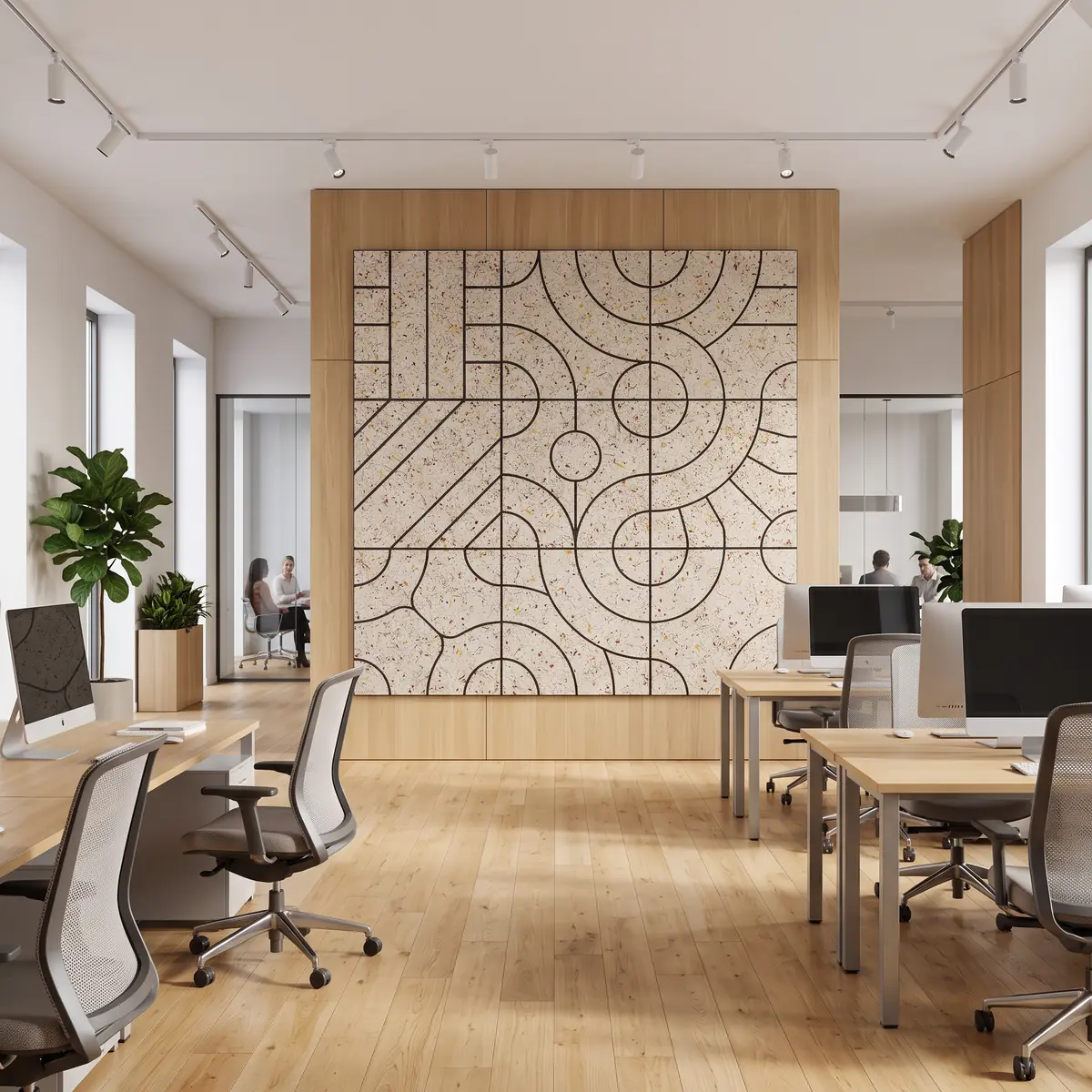
In the office the acoustic benefit is especially clear: less reverberation, fewer distracting background noises and better conditions for focused work and clear conversations. Office acoustic panels do the same in restaurants, cafés, schools, medical practices and shops, wherever many people come together and good speech intelligibility matters.
In living spaces a full-surface solution is rarely needed. A continuous area behind the TV or sofa can calm the room noticeably. The Modular Acoustic Panels are particularly well suited to this. If you want more targeted accents, use Acoustic Pictures or freely combinable Acoustic Tiles.
In the bedroom the material matters as much as the acoustics. Bedroom acoustic panels in the decor WOOL, made of real sheep’s wool, can for example absorb moisture and release it again when the air is drier.
Frequently asked questions about acoustic panels and room acoustics
αw is the weighted sound absorption coefficient according to EN ISO 11654, determined from a measurement in a reverberation room to EN ISO 354. It ranges from 0 to 1.0: 0 means sound is almost entirely reflected, 1 means it is almost entirely absorbed.
Sound absorption works within a room and reduces reverberation. Sound insulation works between two rooms and stops noise from next door getting in. Acoustic panels absorb, they do not insulate.
It depends on the set-up. Mounted directly on the wall they achieve αw 0.45 to 0.55, class D. With 40 mm backfill, a 180 mm wall gap or 140 mm gap plus 40 mm backfill, all decors achieve αw 1.00, class A.
The NRC is a figure based on a US standard. Values slightly above 1.00 are not an error but a measurement effect that can be caused by the edges of the test sample.
Acoustic Panels can be fixed with adhesive film, acoustic rails or mounting adhesive. The fixing method determines the distance to the wall and with it the performance. Each system has its own installation guide in the download area.
Yes. The Active Core can be processed like PET: punching, sawing, waterjet, utility knife or CNC. The MDF carrier board of the Infinity products allows precise adaptation to complex geometries.
No. Against noise from next door only sound insulation in the building element helps, meaning the wall build-up, door, ceiling or floor. Acoustic panels improve the acoustics within your own room.
Yes. Every decor is available as an A5 sample, because a natural surface has to be seen and touched.
Next steps
See what this looks like in finished spaces in our references. All test reports, installation guides and the acoustic brochure are in the download area.
Planning a specific project?
Send us the room size, its use and what is free on the walls or ceiling. You will get a proposal with product, area and set-up, plus the matching test reports.